
What is the Lakou?
"Lakous are widely encompassing of a broader community. Lakous are not only inclusive of biological family members, but also members of a network; neighbors who have become kin and friends who have become part of a larger intimate circle. The lakou as a sacred community, incorporates a kay miste (spirit altars), peristil (temple), and simitye (cemetary)." -Dr. Kyrah Malika Daniels, Healing in the Lakou/Gerizon nan Lakou, Haitian Studies Association
What is a Haitian Vodou Lakou?
The Haitian Vodou lakou is a lineage-led, intergenerational sacred communal space that functions at the intersection of living and the dead. The lakou operates as a spiritual, social, and familial compound that is always in motion, reflecting Vodou’s values of continuity, collective responsibility, and relational balance. An active Vodou lakou typically becomes microeconomy within its immediate geographic area, supporting the surrounding families and communities spiritually, economically, and in some cases, politically. Through spiritual services, shared resources, and communal labor, the lakou offer spiritual healing and community, while generating economic activity and mutual support within its immediate area.
Theological Worldview
The Lakou is Relational Theology & Living Embodiment of the Divine
From a theological perspective, not only is the Vodou Lakou spatially sacred, the dignity of work, community members in and out of the lakou, as well as the divine encounter with an array of spiritual energies such as the spirits and ancestors are deemed sacred. The lakou emphasizes Haitian Vodou's communiothestic nature, helping create and sustain connection with the divine through songs, prayers, rituals, ceremonies, drumming, and communal living.
Photo Credit: Lakou Souvenance, Gonaives Haiti

Communal Function
The Lakou is a Communal & Spiritual Technology of Healing & Survival
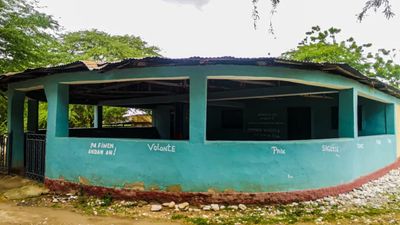
The lakou is a lineage-led, intergenerational sacred communal space that functions at the intersection of living and the dead. It is both a physical and spiritual environment where ancestral memory, ritual practice, and social organization converge. In this context, the lakou is focused on kinship, ancestral memory, and cultural preservation. Lakous are also considered to stimulate economic activity within a community in what is coined as the, "Lakou Effect" by Christie Lindor, HDS MTS '26.
Picture Credit: Lakou Badjo, Gonaives Haiti
The Lakou in Modernity
The Lakou Extends Beyond a Religious Construct
The central idea behind the Lakou is a reclamation of community safe spaces for Haitians, which we see symbolically extend beyond the confines of being viewed as just a religious space. Edward Curtis and Sylvester Johnson discusses the impact of migratory patterns and how that shapes community ontologically, " Black immigrants have established separate churches, mosques, and other religious institutions, but they have also joined and helped to shape existing religious congregations." Curtis and Johnson also describe the Haitian immigrant experience in urbanscapes like Chicago and Boston, " Today, Black congregations of Caribbean Christian immigrants regularly dot the landscapes of America’s urban regions. The Chicago metropolitan area, for instance, boasts multiple congregations of Haitian Baptists, Pentecostals, and Catholics. The city of Boston is likewise a testament to the growing diversity of Caribbean immigrant churches. These parishes not only disseminate theological teachings and spiritual resources through prayer, worship, and scripture reading, but they also constitute a realm of cultural familiarity while sustaining essential networks of support for families who have recently arrived in the city. "
While some religious Haitian communities distance themselves from the term given its spiritual reference, it is not uncommon within Haitian communities for people across religious affiliations to use the language of "the lakou" to describe their interconnectedness with each other as a community.
For example, I use the term "digital lakou" to describe my international podcast community on the Agua Cedito podcast (note: for further deep dives into the lakou and other sacred spaces in Haitian Vodou, check out Episode 48: Honoring Lwa Danti and the Sacred Spaces of Haitian Vodou on the Agua Cedito show)
Photo Credit: Sosyete Nago, Jacmel Haiti
